Modern fraud is getting faster and smarter. Within the corporate landscape, travel expenses represent the largest category requiring specialized audit attention, accounting for 60-75% of all expenses in typical enterprise T&E programs. While organizations frequently focus on obvious infractions, highly sophisticated schemes are often hidden in plain sight. One of the most costly and difficult blind spots to monitor is cancellation and rebooking fraud.
This financial leakage occurs when employees exploit the disconnected nature of booking tools and traditional expense management systems. By manipulating itineraries, malicious actors can cancel business trips for personal credit while the company still foots the bill.
What exactly is cancellation and rebooking fraud?
Cancellation and rebooking fraud thrives in the gray area between travel management companies and expense report reimbursement. This type of employee expense fraud manifests through several specific cancellation fraud types:
- Retained credit abuse: Employees submit expense claims for canceled trips.
- Refund misrepresentation: Full refunds are retained by the employee and not credited back to the company.
- Change fee manipulation: Employees make unnecessary changes to their itineraries to intentionally generate fees.
- Personal trip conversion: A legitimate business trip is canceled, and personal travel is substituted using the company's funds.
Alongside these cancellation tactics, organizations must also perform rigorous rebooking analysis to monitor for fraud patterns. This includes flagging excessive change frequency, which is a pattern of repeated booking changes. It also involves tracking upgrades on rebooking, where an original policy-compliant booking is replaced with a premium rebooking. Furthermore, companies must monitor last-minute changes to justify change fees and conduct partial refund tracking to ensure proper credit allocation.
How are these fraudulent schemes bypassing traditional systems?
Legacy rule-based systems and manual audits are fundamentally unsuitable for tackling this challenge. Traditional audits rely on limited spot checks and lack the sophistication to uncover hidden fraud. They cannot identify long-term patterns of abuse or detect when a submitted itinerary no longer matches the final traveled route.
The core issue is siloed data. If your automated travel expense reporting system does not actively speak to your TMC booking data and corporate card feeds, you are completely exposed. An employee can easily book a compliant flight, generate an itinerary for their expense report, and subsequently cancel that flight directly with the airline for a personal voucher. Without continuous transaction monitoring, the manual approver only sees a compliant booking receipt and approves the reimbursement.
How can corporates effectively bring these costs under control?
To combat sophisticated employee expense fraud, businesses must shift from reactive recovery to proactive fraud prevention. This requires the deployment of AI-powered expense audit software capable of advanced travel expense analysis.
The definitive solution is comprehensive multi-source data validation. By utilizing AI-driven analytics, companies can execute 100% itinerary validation to verify that expense dates align exactly with actual travel dates.
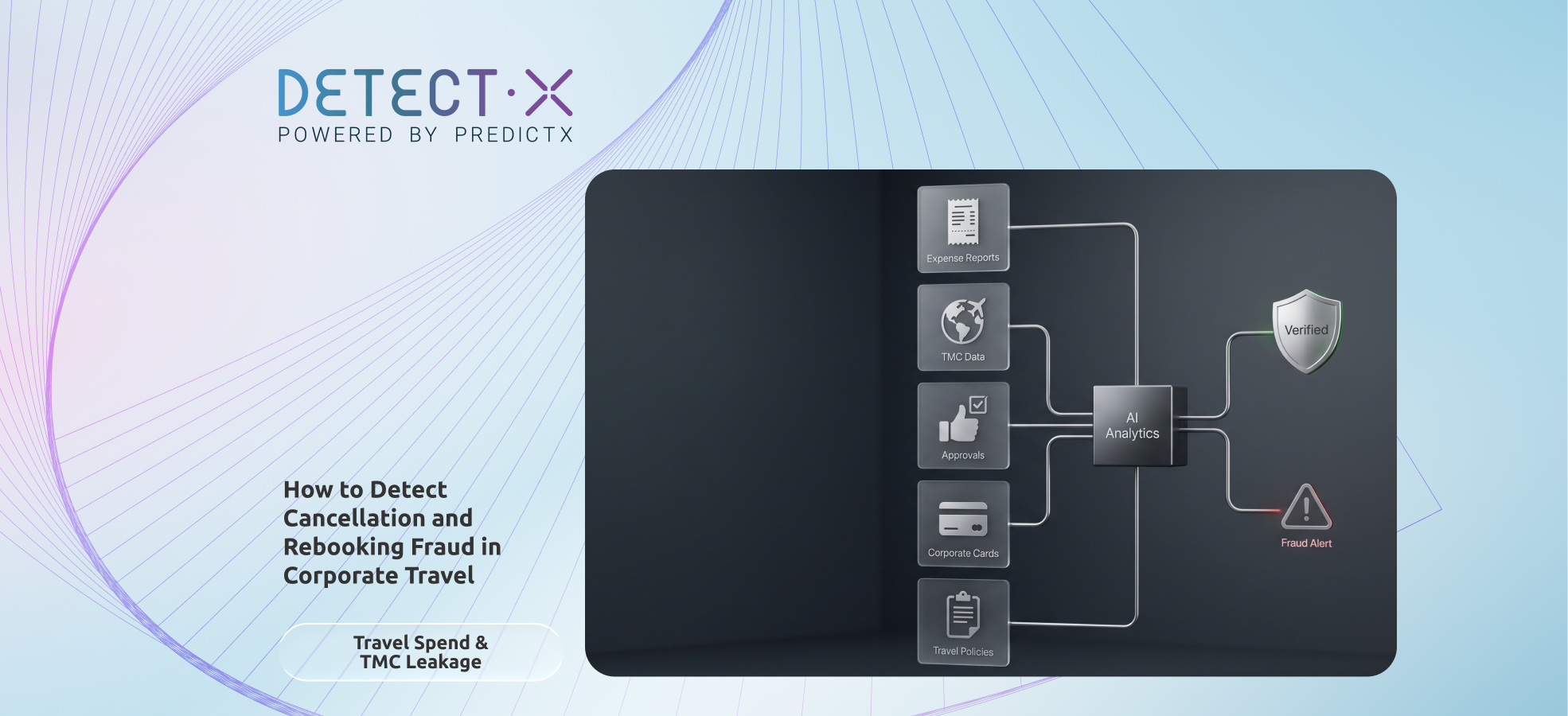
The DetectX Travel Triangulation Engine effectively eliminates these audit blind spots by cross-referencing five critical data sources to construct the complete travel story:
- Expense Reports: The submitted claims from employees.
- TMC Booking Data: The actual reservations, itineraries, and refund records.
- Travel Approvals: The pre-trip authorization records.
- Corporate Card Transactions: The real-time card swipe data.
- Travel Policies: The specific company rules and compliance requirements.
By leveraging this level of corporate travel data analytics, the system executes real-time fraud detection. It automatically cross-checks travel bookings against actual itineraries, including flights, lodging, and cancellations. If an employee submits an expense claim for a canceled booking, the system immediately identifies the timeline gap or missing submission. Furthermore, this continuous automated expense auditing flags ghost expense scenarios, successfully identifying mismatches between claims and bookings automatically.
Are you tracking the full story of your corporate travel?
Merely tracking what was spent is no longer sufficient. Travel leaders must deploy automated audit software to demand complete visibility into the lifecycle of every booking. Integrating advanced travel expense management solutions ensures unwavering business travel compliance. By adopting intelligent travel expense tools that triangulate data across the entire ecosystem, corporates can finally eliminate financial leakage, halt anomalous spend, and protect their bottom line with unmatched precision.
Related Posts

Modern Fraud Challenges: Outpacing Traditional Defenses

The Hidden Cost of Manual Audits: How AI Automates Expense Review & Boosts ROI